How to find undervalued FTSE 250 stocks
The FTSE 250 is where UK mispricing tends to survive longest — less analyst coverage, more domestic exposure, and a market that marks the whole index down when the UK economy is out of favour. It is also where the checks matter most.
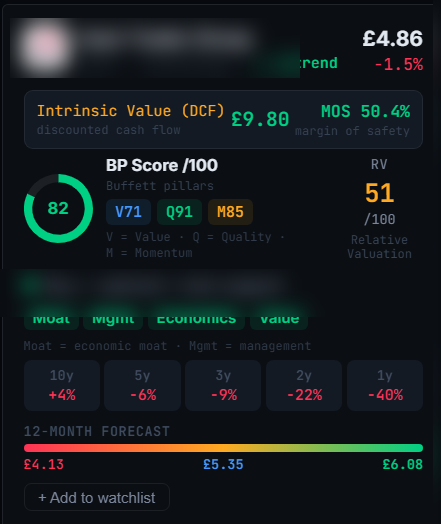
An example Oak Growth stock card, showing estimated intrinsic value against the current price, the resulting margin of safety, and which of the four Buffett pillars a business passes. Illustrative only — the company name and entry signal are obscured, and any figures shown were correct at July 2026. Not a recommendation to buy or sell any security.
Why the FTSE 250 is a different hunting ground
The FTSE 100 is a global index that happens to be listed in London — miners, oil majors, banks and pharma groups earning most of their revenue abroad. The FTSE 250 is much closer to a bet on Britain: housebuilders, retailers, regional banks, engineers, transport and support services, with a far larger share of earnings made domestically.
That matters for valuation in two ways. Mid-caps get less analyst coverage than the mega-caps, so mispricing survives longer. And the index moves with UK interest rates, wage growth and consumer confidence rather than the oil price, which means the whole index can be marked down for reasons that have nothing to do with any individual company in it.
What “undervalued” means here
The same thing it means anywhere. A share is undervalued when it trades below the discounted value of the cash the business can generate for its owners — its intrinsic value — not because the price chart has fallen. The gap between the two is your margin of safety.
What changes in the mid-cap space is the failure rate. A FTSE 100 company that gets into trouble usually has the balance sheet to survive it. A FTSE 250 company that has taken on debt into a downturn may not, so the quality checks carry more weight, not less.
The checks that matter most in mid-caps
Debt, before anything else
Look at debt to equity and, more importantly, whether operating profit comfortably covers the interest bill. Mid-caps borrow at worse rates than mega-caps and refinance more often. A cheap-looking share with thin interest cover is a leveraged bet on rates falling, whatever the P/E says.
Cash conversion
Does reported profit turn into free cash flow? Working-capital-hungry businesses — contractors, distributors, anything that builds before it bills — can report profits for years while generating nothing. Compare cumulative operating cash flow against cumulative net income over five years.
Return on capital through a cycle
One good year proves nothing. Return on invested capital that holds up across the last downturn is evidence of something durable. Averaging it over five years filters out the businesses that only work when conditions are perfect.
A moat that survives at this size
Mid-caps rarely have global brands. Their moats tend to be narrower and more local: regulatory licences, entrenched B2B relationships, switching costs in software or logistics, or dominance of a niche too small for a giant to bother entering. Narrow is fine. Absent is not.
Two practical differences from large caps
Liquidity. Spreads are wider further down the index and daily volumes are thinner. A position you can build over a week may take longer to exit if sentiment turns. Size positions accordingly.
Takeovers. Persistently undervalued UK mid-caps have been a regular hunting ground for private equity and overseas trade buyers. That can crystallise value quickly — and it can also mean a business you wanted to own for a decade disappears at a price you would not have chosen.
Doing it across 250 companies
Valuing one mid-cap by hand is a good afternoon's work. Doing it across the whole index is not realistic manually, which is the problem Oak Growth was built to solve: it estimates intrinsic value and margin of safety across 145 FTSE 250 constituents alongside the FTSE 100 and eight other markets, and scores each on moat, management, economics and value.
See FTSE 250 companies ranked by margin of safety
Oak Growth estimates what each business is worth, shows the gap against today's price, and scores all four Buffett pillars — across the FTSE 250, the FTSE 100 and seven more markets.
Explore Oak GrowthCommon questions
How do you find undervalued FTSE 250 stocks?
Estimate what each business is worth from the cash it can generate, then compare that to the share price. A meaningful discount plus strong return on capital, comfortable interest cover and real cash conversion suggests genuine undervaluation rather than a share that is cheap for good reason.
Is the FTSE 250 better value than the FTSE 100?
They are different exposures rather than one being better. The FTSE 100 earns most of its revenue overseas, while the FTSE 250 is far more geared to the domestic UK economy and gets less analyst coverage, which can leave mispricings in place longer. Neither index is uniformly cheap or expensive.
Are FTSE 250 shares riskier than FTSE 100 shares?
Generally yes. Mid-caps are more sensitive to the UK economic cycle, carry thinner trading liquidity, and have less balance sheet capacity to absorb a bad year. That is why debt and cash conversion checks matter more here than at the top of the market.
How many FTSE 250 companies does Oak Growth cover?
145 FTSE 250 constituents are scored in the app alongside the FTSE 100, US, European, Japanese, Hong Kong and Australian markets, each with an estimated intrinsic value, a margin of safety figure and the four Buffett pillar checks.
Also see: Undervalued FTSE 100 stocks → · How to find undervalued UK stocks → · Cheap quality UK stocks →
Also see: Are UK defence stocks overvalued? → · Undervalued S&P 500 stocks →