How to spot undervalued FTSE 100 stocks
The FTSE 100 holds the UK's largest, most heavily analysed companies — so genuine bargains are less common than people assume, but they do appear when the market overreacts. Here's how to find them.
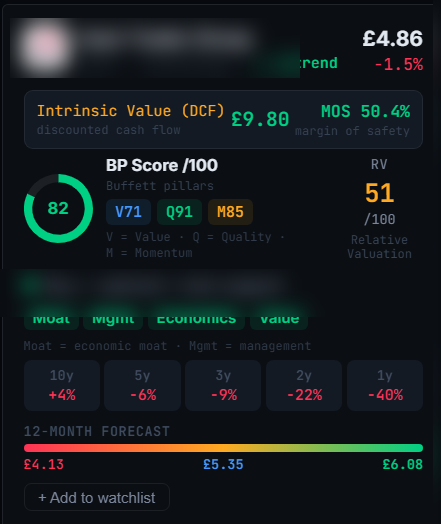
An example Oak Growth stock card, showing how the app presents estimated intrinsic value against the current price, the resulting margin of safety, and which of the four Buffett pillars a business passes. Illustrative only — the company name and entry signal are obscured, and any figures shown were correct at July 2026. Not a recommendation to buy or sell any security.
Why the FTSE 100 can still throw up value
These are the UK’s biggest listed businesses, followed by dozens of analysts each. Obvious mispricings get arbitraged away quickly. What creates opportunity is overreaction — a weak set of results, a sector falling out of favour, or broad pessimism about the UK dragging a strong company below what it’s worth.
It happens more often than you’d think. A business can hold its earnings, dividend and balance sheet steady while its share price falls 30% — and that gap is exactly what a value investor is looking for.
How to judge whether a FTSE 100 share is cheap
Start with intrinsic value
Value the business on the cash it can generate, discounted to today. If the price sits well below that figure, it may be undervalued — see our intrinsic value guide.
Check the margin of safety
The wider the gap between intrinsic value and price, the more room you have to be wrong. Value investors typically want a meaningful discount, not a marginal one.
Confirm the quality holds
Strong return on equity, healthy free cash flow and low debt distinguish a temporarily-cheap quality business from one in genuine decline.
Look past the dividend yield
A very high yield on a FTSE 100 share is often a warning, not a gift — it can mean the market expects a cut. Check whether earnings and cash flow actually cover it. See dividend yield.
The value investor’s edge in a large-cap index
Buffett built much of his record inside large, well-covered indices by ignoring the noise and buying strong businesses when they were temporarily out of favour. The method transfers directly to the FTSE 100: know what a company is worth, wait until the price falls below it, and insist on a margin of safety before you act.
Screen the FTSE 100 for genuine value
Oak Growth ranks FTSE 100 and global stocks by margin of safety, so temporarily-mispriced quality businesses stand out at a glance.
Explore Oak GrowthCommon questions
Are there undervalued stocks in the FTSE 100?
Yes, though they're less common than in smaller, less-covered parts of the market. Value typically appears when the market overreacts to short-term news, temporarily pushing a quality business below its intrinsic value.
How do I find undervalued FTSE 100 shares?
Estimate each company's intrinsic value from its fundamentals, then compare that to the current share price. Focus on businesses with strong return on equity and low debt trading at a meaningful discount. A screener automates this across all 100 constituents.
Is a high dividend yield a sign a FTSE 100 stock is undervalued?
Not necessarily. An unusually high yield often signals that the market expects the dividend to be cut. Check whether earnings and free cash flow comfortably cover the payout before treating a high yield as a bargain.
Also see: How to find undervalued FTSE 250 stocks → · How to find undervalued UK stocks →
Also see: Why is the FTSE 100 falling? →
Also see: HSBC (HSBA) intrinsic value → · Shell (SHEL) intrinsic value →
Also see: Lloyds (LLOY) analysis → · BT (BT.A) analysis →