How to find undervalued UK stocks
A UK stock is undervalued when it trades below what the business is actually worth — not simply because the price has fallen. Here's how to tell the difference, using the approach Buffett built his record on.
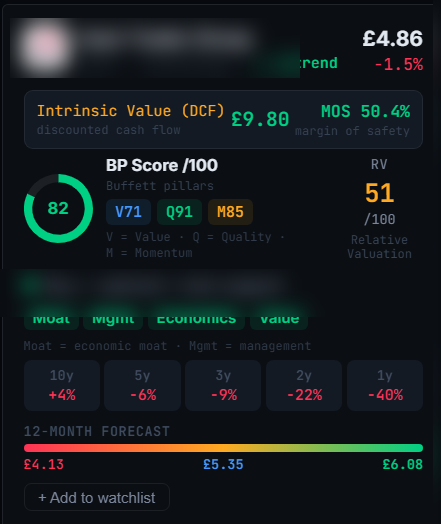
An example Oak Growth stock card, showing how the app presents estimated intrinsic value against the current price, the resulting margin of safety, and which of the four Buffett pillars a business passes. Illustrative only — the company name and entry signal are obscured, and any figures shown were correct at July 2026. Not a recommendation to buy or sell any security.
What “undervalued” really means
A share price falling doesn’t make a stock cheap. It’s only cheap relative to what the business is worth — its intrinsic value, the cash it can generate for owners over time, discounted back to today. The gap between that figure and the price is your margin of safety.
The UK market’s particular opportunity
UK-listed shares have spent years trading at a discount to their US equivalents, which means genuine quality can sit at prices that would look surprising across the Atlantic. That’s the opportunity — but it also means you have to be careful, because some UK shares are cheap for good reason.
The four checks that matter
Margin of safety
How far below intrinsic value it trades. A discount of 15% or more gives you a cushion if your valuation proves too optimistic. This is the single most important value signal.
Return on equity
Undervalued shouldn't mean broken. Consistent ROE above 15% shows the business earns well on its capital — you're buying quality at a discount, not a failing company.
Debt to equity
Below about 0.5. High borrowing turns a cheap share into a risky one, and means the discount may reflect distress rather than opportunity. See our guide to debt-to-equity.
A durable moat
Something rivals can't easily copy — a brand, a network, switching costs. Without it, today's profits get competed away. See economic moats.
Where UK value tends to hide
Rarely in whatever the market is currently excited about. More often in solid businesses the market has temporarily soured on — a disappointing set of results, an out-of-favour sector, or a share price that has fallen much further than the underlying earnings justify. The discipline is always the same: estimate the worth, compare it to the price, insist on a margin of safety.
Doing it across the whole market
Valuing one company by hand is a good exercise. Doing it across hundreds of UK listings isn’t practical. That’s the problem Oak Growth solves — it calculates intrinsic value and margin of safety across the FTSE and global markets, so the undervalued quality names surface automatically.
See undervalued UK stocks ranked by margin of safety
Oak Growth calculates intrinsic value and margin of safety across UK, US and European markets — and flags the quality businesses trading at a genuine discount.
Explore Oak GrowthCommon questions
How do you know if a UK stock is undervalued?
Compare its share price to its intrinsic value — the discounted value of the cash the business will generate. If the price sits meaningfully below that, and the company has strong returns on equity and low debt, it may be genuinely undervalued rather than simply cheap.
Are UK shares cheaper than US shares?
UK-listed companies have generally traded on lower valuation multiples than comparable US companies in recent years. That can create opportunity, but a lower multiple alone doesn't make a share good value — the underlying business quality still has to hold up.
What is a value trap?
A value trap is a share that looks cheap but is priced low because the business is genuinely declining. Checking return on equity, cash flow and debt levels is what separates a real bargain from a value trap.
Also see: How to find undervalued US stocks → · How to find undervalued European stocks → · Undervalued FTSE 250 stocks →
Also see: AstraZeneca → · Barclays → · Vodafone →