How to find cheap, quality UK stocks
Cheap is easy to find. Quality is easy to find. Both at once — a strong British business trading below what it's worth — is rare, and it's the entire point of value investing. Here's how to spot it.
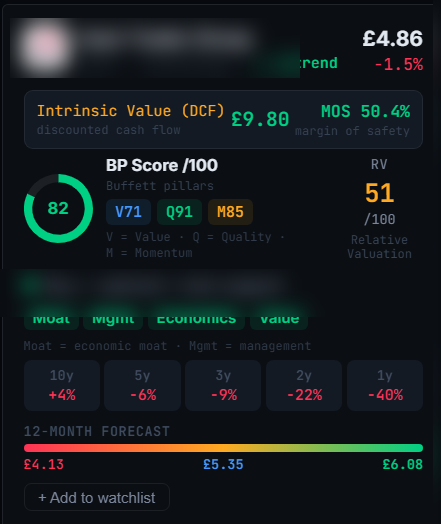
An example Oak Growth stock card, showing how the app presents estimated intrinsic value against the current price, the resulting margin of safety, and which of the four Buffett pillars a business passes. Illustrative only — the company name and entry signal are obscured, and any figures shown were correct at July 2026. Not a recommendation to buy or sell any security.
Cheap and quality are not the same thing
Plenty of UK shares are cheap because the business is struggling. Plenty of excellent companies are expensive because everyone already knows they’re excellent. The prize — and the difficulty — is the overlap: a genuinely strong business trading below its worth. Buffett’s phrase for it is “a wonderful business at a fair price.”
How to measure quality
High return on equity
Consistently above 15–18% shows the business earns strong returns on the capital it employs — the signature of a durable, well-run company. See return on equity.
Strong free cash flow
Real cash, not just accounting profit. A quality business converts earnings into cash it can reinvest or return to shareholders — see free cash flow.
Low debt
A debt-to-equity ratio below about 0.5 means the company isn't propping up returns with borrowing, and can withstand a downturn.
A durable moat
A brand, network or cost advantage that stops competitors eroding profits. See our guide to economic moats.
Then, and only then, look at the price
Once quality is established, cheapness is the gap between the share price and the company’s intrinsic value. A quality UK business trading at a genuine margin of safety is the rare combination worth acting on.
Why order matters
Screening for cheap shares first produces a list dominated by companies in trouble. Screening for quality first, then filtering by price, produces something far more useful: good businesses you’d be happy to own, of which a handful happen to be trading at a discount right now. That ordering is built into how Oak Growth works.
Find cheap, quality UK stocks automatically
Oak Growth screens UK, US and European markets for the rare overlap: quality businesses trading at a genuine margin of safety.
Explore Oak GrowthCommon questions
What are cheap quality stocks?
Cheap quality stocks are strong, well-run businesses — high return on equity, low debt, durable competitive advantages — that happen to trade below their intrinsic value. The combination is rare because quality usually commands a premium.
How do you find quality UK stocks that are also cheap?
Screen for quality first: consistent high return on equity, strong free cash flow, low debt and a durable moat. Then check which of those trade below intrinsic value at a margin of safety. That overlap is where value investors focus.
Why are some UK stocks so cheap?
Reasons vary — broad pessimism about the UK market, a sector falling out of favour, or genuine problems at the company. The quality checks are what tell you which of those you're looking at.
Also see: How to find cheap quality US stocks →